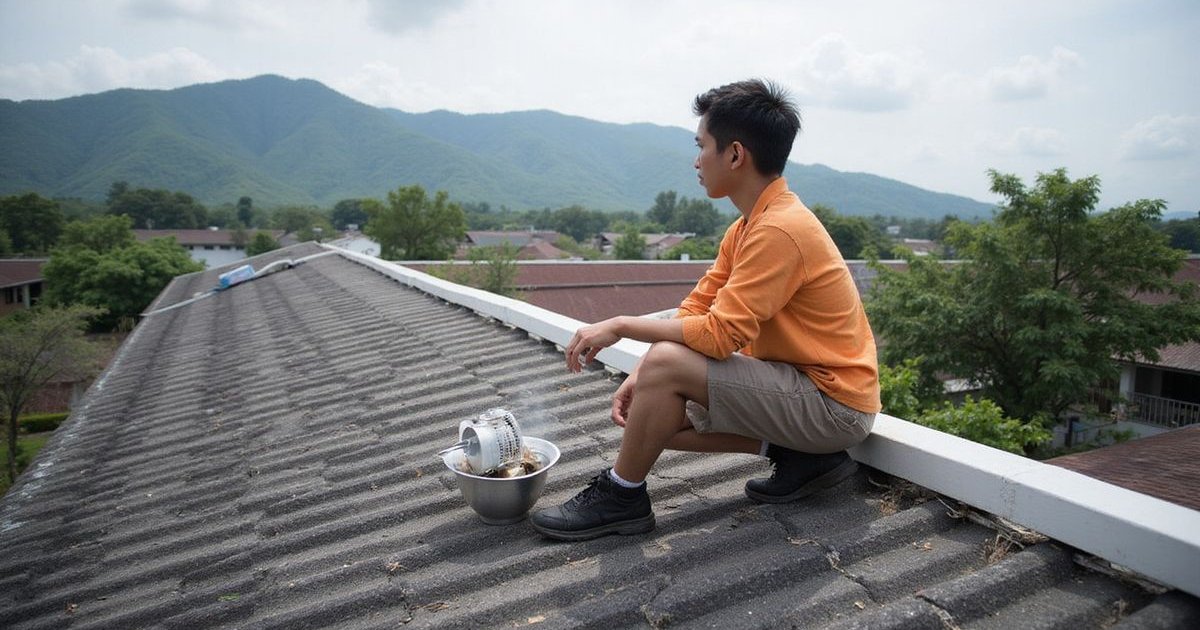
You know that feeling when you walk upstairs at 2 PM and the heat hits you like a physical wall?
Living in the Klang Valley means dealing with an intense “urban heat island” effect that turns your roof into a radiator.
We established Roofing Man in 2013, and with over 16 years of hands-on industry experience, our team has seen exactly what the Malaysian sun does to concrete tiles and metal decks.
Most homeowners think full replacement is the only solution for an aging, hot roof.
There is actually a more efficient middle ground that addresses both heat and minor leaks.
Here is a breakdown of the 5 benefits of roof coating for Malaysian homes, backed by data we see in the field every day.
1. Significant Heat Reduction (The “Cool Roof” Effect)
Malaysia’s equatorial sun heats standard roof surfaces to extreme temperatures, often reaching 70°C to 80°C by mid-afternoon.
We utilize specialized reflective coatings that work much like a mirror for solar radiation.
These products are formulated with high Solar Reflectance Index (SRI) values, which measure a material’s ability to reject solar heat.
The Real Numbers
By applying a professional-grade reflective coating, you can expect measurable changes:
- Surface Temperature Drop: From ~75°C down to ~45°C.
- Solar Reflection: Deflects up to 85% of UV radiation.
- Indoor Comfort: Reduces ambient indoor temperature by 3°C to 5°C.
This difference is most noticeable in double-storey terrace houses in areas like Petaling Jaya, where the upper master bedroom often becomes unusable during the day.
Reducing the roof surface temperature stops the heat transfer before it saturates your ceiling insulation.
2. Extended Roof Lifespan Through Thermal Shock Prevention
Your roof goes through a brutal cycle every single day.
It bakes in the 34°C heat and then rapidly contracts when a sudden thunderstorm hits in the evening.
We call this “thermal shock,” and it is the primary cause of hairline cracks in concrete tiles and metal fatigue in industrial roofing.
How Coating Acts as a Shield
A protective coating serves as a sacrificial layer against these elements.
- UV Barrier: It prevents ultraviolet rays from drying out the binders in concrete tiles, stopping them from becoming brittle.
- Elasticity: Quality coatings (especially elastomeric types) can stretch up to 300%, bridging hairline cracks that form during expansion and contraction.
- Anti-Carbonation: It stops pollutants from degrading the structural integrity of the tiles.
Applying this layer adds 5 to 10 years to the service life of your existing roof.
3. Lower Energy Bills (TNB Savings)
A cooler roof directly translates to a lower workload for your air conditioning units.
When your roof surface is 20°C cooler, less heat radiates down into your living space.
We have observed that air conditioning compressors do not have to work as hard to maintain a set temperature of 24°C.
The Efficiency Impact
Data suggests that for every 1°C decrease in indoor temperature, cooling energy costs can drop by approximately 3-5%.
- Reduced Usage: You might not need to turn the AC on until later in the day.
- Equipment Longevity: Less strain on your AC compressor means it lasts longer.
- Peak Load Drop: Your home consumes less electricity during the hottest, most expensive hours.
For commercial buildings in KL, this reduction in cooling load is often the primary reason owners choose to coat rather than replace.
4. Improved Appearance and Property Value
Curb appeal matters, especially if you are looking to sell or rent your property in a competitive market like the Klang Valley.
Algae, fungus, and accumulated soot can make a 15-year-old house look significantly older than it is.
Our team frequently applies coatings to refresh the aesthetic of faded Terracotta or grey concrete tiles.
Visual Benefits
- Uniformity: Hides patch repairs and mismatched tiles.
- Modernization: Changes the color scheme without the cost of new tiles (e.g., switching from faded red to modern dark grey).
- Cleanliness: High-quality coatings often include anti-fungal properties that keep the roof looking clean for years.
A freshly coated roof signals to buyers that the property has been well-maintained.
5. Cost-Effective Protection vs. Replacement
The price difference between coating and re-roofing is the most compelling factor for most families.
We advise homeowners to look at the numbers side-by-side to understand the value proposition.
Replacing an entire roof involves demolition, disposal fees, and significant labor costs.
2026 Cost Comparison (Estimates for Klang Valley)
| Service Option | Estimated Cost (Terrace House) | Disruption Level | Lifespan Added |
|---|---|---|---|
| Roof Coating | RM 3,500 - RM 8,500 | Low (1-2 Days) | 5-10 Years |
| Major Repairs | RM 6,000 - RM 15,000 | Medium (3-5 Days) | Varies |
| Full Replacement | RM 25,000 - RM 55,000 | High (1-2 Weeks) | 20-30 Years |
Note: Prices vary based on roof size (sq ft), pitch, and access difficulty.
Coating provides a viable extension of life for a fraction of the replacement cost.
Is Roof Coating Right for Your Home?
Not every roof is a good candidate for this process.
We adhere to a strict assessment protocol to ensure you do not waste money coating a roof that is structurally unsound.
The Ideal Candidate
- Material: Concrete tiles, clay tiles, or metal deck (zinc).
- Condition: Structurally sound but suffering from surface erosion or minor hairline cracks.
- Goal: Primarily heat reduction and extending life, rather than fixing major structural leaks.
When to Avoid Coating
- Rotting Timber: If the wooden truss underneath is rotting, coating the top won’t help.
- Severe Leaks: Coating is water-resistant, but it is not a magic fix for large holes or broken tiles.
- Flat Concrete Roofs: These usually require specialized waterproofing membranes (like torch-on), not just standard liquid coating.
Choosing the Right Coating Material
The market is flooded with “waterproofing paints,” but they are not all created equal.
We select materials based on the specific exposure of your roof.
Acrylic vs. Polyurethane (PU)
| Feature | Acrylic Coating | Polyurethane (PU) Coating |
|---|---|---|
| Primary Use | Heat reflection & aesthetics | Heavy-duty waterproofing |
| UV Stability | Excellent | Good |
| Ponding Water | Weak (Can blister) | Strong (Resists standing water) |
| Cost | Budget-friendly | Premium |
For most steep-slope residential roofs in Malaysia, a high-grade Acrylic reinforced with fibers is the standard choice.
Common Questions
How long does the coating actually last? High-quality acrylics typically last 5 to 7 years, while premium PU systems can last 10 years or more with proper maintenance.
Can I just paint it myself? DIY painting often fails because the surface wasn’t high-pressure cleaned (3,000+ PSI) first. Without that prep, the new paint peels off within months.
Will this stop my active leak? It will seal hairline cracks (micro-fissures). However, if you have a broken tile or a failed flashing, those must be physically repaired before any coating is applied.
Does color affect the temperature? Yes. White or light grey reflects the most heat. Darker colors absorb more heat, even with reflective technology, so we recommend lighter shades for maximum cooling.
Get a Free Assessment
You don’t have to guess whether your roof needs a repair, a coating, or a full replacement.
We offer a comprehensive inspection for homeowners in KL and Petaling Jaya to give you the honest facts.
Contact us today to schedule your assessment and see if roof coating is the smart move for your home.