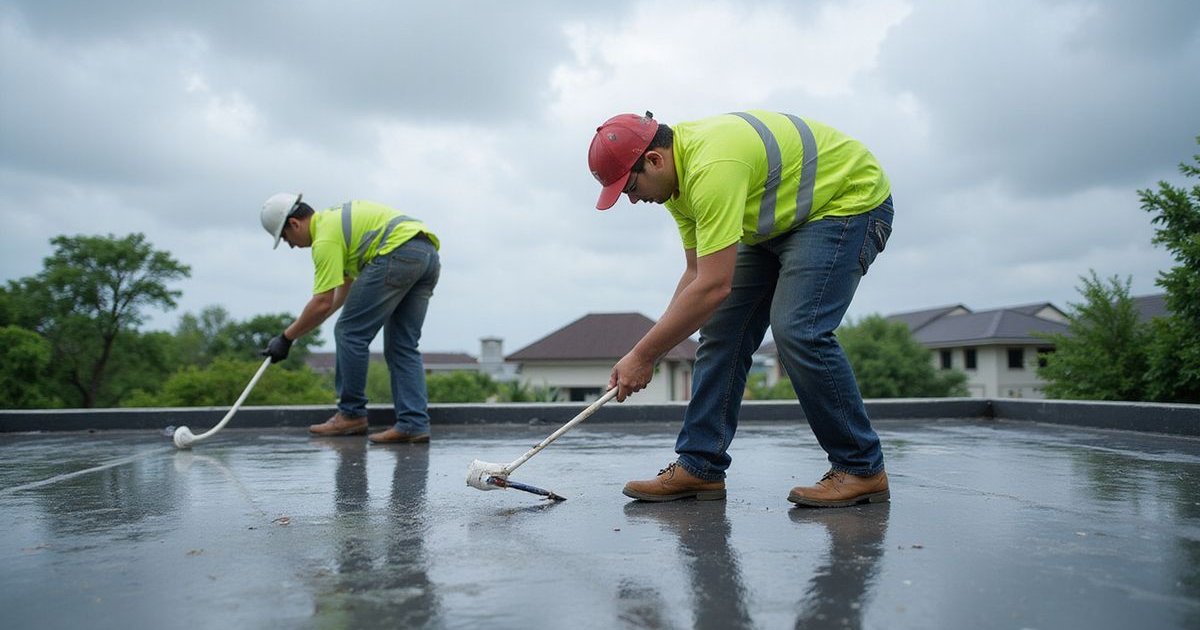
Complete Guide to Flat Roof Waterproofing in Malaysia
If you own a property in the Klang Valley, you know that sinking feeling when the afternoon sky turns dark in November. We have all stared at a ceiling stain, hoping it doesn’t grow larger as the rain starts to hammer down.
Our team at Roofing Man was established in 2013 to solve exactly this kind of headache for Malaysian homeowners. Dealing with tropical storms for over 16 years has taught us that a “small leak” is rarely just a small problem.
It usually points to a failure in the building’s primary defense system.
This guide breaks down exactly how to protect your flat roof using methods that actually withstand our local climate.
Why Flat Roofs in Malaysia Face Special Challenges
A flat roof in Petaling Jaya or KL faces a much tougher life than one in a temperate climate.
Our intense tropical sun heats concrete surfaces up to 60°C during the day. Then, a sudden afternoon thunderstorm can drop that temperature by 30 degrees in minutes. This “thermal shock” causes rapid expansion and contraction that cracks rigid concrete over time.
You also have to contend with:
- Water Ponding: Flat roofs rarely drain as fast as pitched ones, allowing water to sit and find microscopic weaknesses.
- High Humidity: Malaysia’s 90%+ humidity levels can trap moisture under poor waterproofing, causing bubbling.
- Structural Movement: As the building settles, rigid waterproofing materials often snap instead of stretching.
Proper waterproofing isn’t just about stopping water; it is about managing these extreme environmental stresses.
Types of Waterproofing Systems
Choosing the right material is the most critical decision you will make. We have tested dozens of products, and we generally categorize them into four main systems suitable for Malaysian buildings.
1. Torch-Applied Membrane (Bituminous)
This is the heavy-duty option you often see on commercial buildings and condos.
Our installers use a gas torch to melt a layer of bitumen on the back of a modified asphalt sheet, bonding it directly to the concrete.
Why it works:
- Extreme Durability: It creates a thick, tough layer that resists punctures.
- Uniform Thickness: Unlike liquids, the factory-made sheet ensures the same thickness everywhere.
- Ponding Resistance: It handles standing water better than most liquid coatings.
The Trade-off: It is not a DIY-friendly option. The installation involves open flames and requires specific overlap techniques to ensure the seams don’t fail.
2. Liquid-Applied Membrane (PU vs. Acrylic)
This is where many homeowners get confused because not all “waterproofing paints” are the same.
We recommend understanding the difference between Polyurethane (PU) and Acrylic.
Acrylic Coatings:
- Best for: Steep slopes or walls where water runs off immediately.
- The Reality: These are cheaper and UV stable, but they often lack the flexibility to bridge moving cracks and can fail if water ponds on them.
Polyurethane (PU) Coatings:
- Best for: Flat concrete roofs with potential for slight movement or ponding.
- The Reality: PU is highly elastic (some stretch over 600%), allowing it to bridge hairline cracks without tearing. It usually requires a UV-resistant topcoat if exposed to direct sun.
3. Self-Adhesive Membrane
Think of this as a giant, industrial-strength sticker.
Our team often uses this for smaller repairs or areas where using a torch is too dangerous due to fire hazards.
Pros:
- Safer Installation: No open flame is required.
- Consistent Quality: Like torch-on, the factory controls the thickness.
- Immediate Protection: It is waterproof the moment it sticks.
Cons: The surface preparation must be perfect. Even a little dust can prevent the adhesive from bonding, leading to failure within months.
4. PVC/TPO Membrane
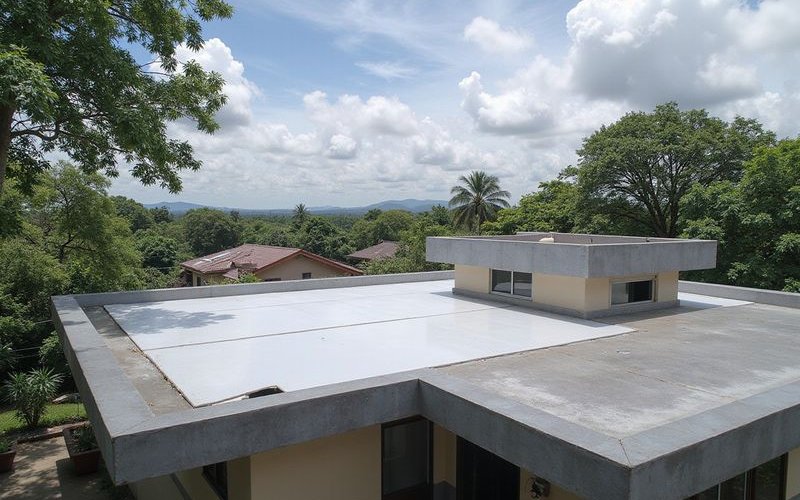
These are single-ply synthetic sheets that are mechanically fixed or adhered and then heat-welded at the seams.
The Verdict:
- Premium Performance: These reflect heat well (keeping the building cooler) and last a very long time.
- Cost: This is typically the most expensive option and is usually reserved for large commercial projects or premium residential builds.
Quick Comparison: Which System is Right for You?
| Feature | Torch-On Membrane | Liquid PU | Acrylic Coating |
|---|---|---|---|
| Best Use | Large concrete roofs | Balconies & complex shapes | Sloped roofs & walls |
| Flexibility | Moderate | High | Low |
| Ponding Water? | Yes | Yes (if specified) | No |
| Est. Lifespan | 15-20 Years | 10-15 Years | 3-5 Years |
| Cost | High | Medium-High | Low |
The Waterproofing Process: How We Do It
Great material applied poorly will still leak.
We follow a strict 5-step protocol to ensure the system holds up against the Malaysian monsoon.
Step 1: Surface Preparation (The Most Important Step)
You cannot waterproof a dirty or wet surface.
- Cleaning: We use high-pressure jets to remove algae, moss, and loose debris.
- Drying: The concrete must be moisture-free. Trapping water under the membrane causes “blistering” when the sun heats it up.
- Priming: A specific primer is applied to help the membrane bond to the porous concrete.
Step 2: The “Angle Fillet” Treatment
Water loves to sneak in where the floor meets the wall.
- The Fix: We install an “angle fillet” (or chamfer)—a 45-degree mortar ramp at these corners.
- The Reason: This prevents the waterproofing membrane from bending at a sharp 90-degree angle, which is where it usually cracks.
Step 3: Membrane Application
This stage depends on the system chosen.
- Liquid Systems: We apply multiple coats (usually a primer, two body coats, and a top coat) in cross directions to ensure no pinholes remain.
- Sheet Systems: We carefully align the sheets with a minimum 100mm overlap to ensure water cannot travel between layers.
Step 4: The Ponding Test
You should never pay for a job until it has been tested.
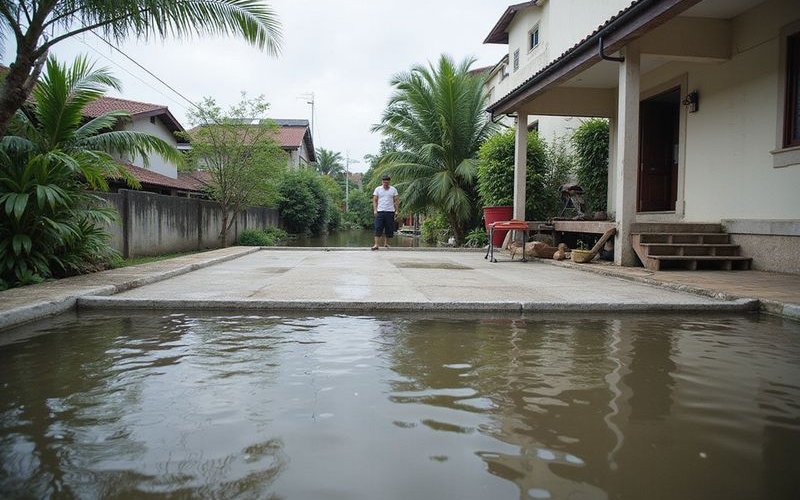
- The Method: We plug the drain outlets and flood the roof with water.
- The Duration: We leave it for at least 24 to 48 hours.
- The Result: If the ceiling below is dry after two days of standing water, the system is secure.
Step 5: Protection Layer
Exposed membranes degrade faster.
- Screed: A layer of cement screed protects the membrane from UV rays and foot traffic.
- Tiles: Great for balconies, but ensure the waterproofing below is a flexible cementitious or PU type.
Common Mistakes to Avoid
Ignoring the Gradient (The 1:80 Rule) Flat roofs shouldn’t be perfectly flat. They need a slight slope (ideally 1:80) to direct water to the drainage outlets. If your contractor leaves depressions where water sits for weeks, algae will grow and eat through the coating.
Applying Over Cracks Painting over a crack is like putting a plaster on a broken bone. We always repair active cracks with flexible sealants or reinforcement fabric before applying the main waterproofing layer.
The “Weekend Warrior” Approach Buying a tin of cheap “waterproof paint” from the hardware store is a temporary patch, not a solution. These products rarely have the thickness or UV stability to survive more than six months on a roof exposed to our weather.
Maintenance Tips for Longevity
Even the best system needs care.
- Pre-Monsoon Check: Clear your drains and gutters in March and September, right before the heavy rain seasons.
- Debris Removal: Dead leaves trap moisture and release acids that can damage some membranes.
- Avoid Punctures: Never nail anything (like satellite dishes or clotheslines) directly through the waterproofing layer.
Cost Factors for 2026
Pricing varies based on roof size and condition, but here is what you can expect for professional work in the Klang Valley right now.
Estimated Market Rates:
- Cementitious Systems: Starting from RM 5.00 - RM 6.00 per sq ft.
- Liquid PU/Acrylic Hybrids: Starting from RM 6.00 - RM 8.00 per sq ft.
- Torch-On Membranes: Starting from RM 8.00 - RM 12.00+ per sq ft.
Repair Costs:
- PU Injection (for localized leaks): RM 45.00+ per injection point.
Please note that these are starting estimates. High-rise access, extensive surface repairs, or hacking up old tiles will increase the final cost.
Getting It Right
Flat roof waterproofing is technical work that requires specific knowledge of materials and hydrology.
Our team at Roofing Man believes that doing it right the first time is always cheaper than doing it twice. You need a solution that accounts for thermal shock, structural movement, and torrential rain.
Don’t wait for the ceiling to collapse before taking action.
Need Flat Roof Waterproofing?
Contact us for a free assessment of your flat roof. We’ll inspect the condition, recommend the appropriate waterproofing system, and provide a detailed quote.