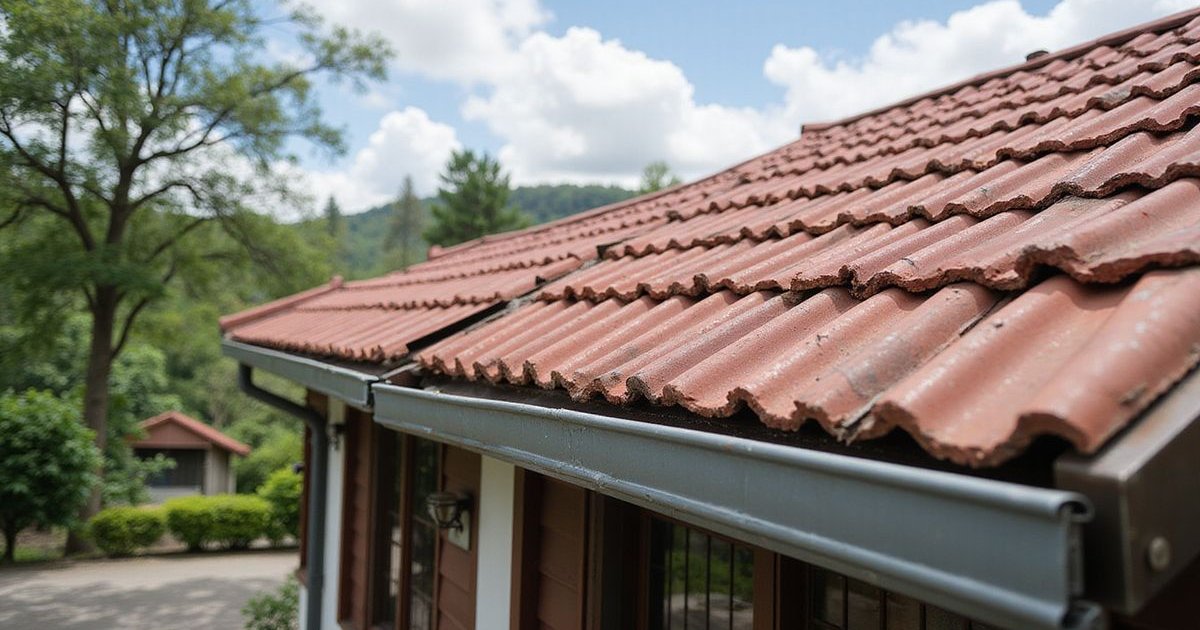
This article will provide an expert comparison of gutter materials specifically for the Malaysian climate, written from the perspective of “Roofing Man” (established 2013).
Choosing the right gutter material is often the difference between a dry ceiling and a frantic call to us during the monsoon season. We see it every year: a homeowner installs the cheapest option in January, only to face overflowing cascades by November.
From our experience fixing roofs across the Klang Valley since 2013, the choice between PVC and metal isn’t just about price—it’s about surviving our unique weather. The sheer volume of water that hits a Malaysian roof during a “sumatra” squall (often exceeding 100mm per hour) demands more than just a standard drain.
In this guide, we’re going to break down the real-world performance of these materials, compare their latest 2026 installation costs, and explain why the “thickness” of your metal gutter matters more than you think.
PVC (Plastic) Gutters
Pros
- Most Affordable Entry Point: This is consistently the cheapest option per linear foot.
- Corrosion-Proof Material: Plastic simply cannot rust, which is a massive plus in coastal areas.
- Lightweight Construction: We can install these quickly without reinforcing your fascia boards.
- Quieter Operation: Raindrops hitting plastic create a dull thud rather than a metallic ping.
- Standardized Parts: Brands like Arensi-Marley have made finding replacement joints very easy at local hardware stores.
- Easy Sectional Repair: If one part cracks, you can snap in a new piece without removing the whole run.
Cons
- UV Degradation: Our intense tropical sun breaks down the polymer bonds, turning cheap PVC brittle and yellow within 3-5 years.
- Joint Failure: The rubber seals in the connectors often dry out and shrink long before the pipe itself fails, causing drips.
- Thermal Expansion Issues: PVC expands significantly in heat; without proper expansion gaps, it warps and snaps brackets.
- Limited Water Capacity: Most standard residential PVC gutters are 100mm (4 inches), which often overflows during KL’s heaviest flash floods.
- Sagging Risk: We frequently see these sagging because the plastic lacks the rigidity to bridge wide rafter spacings.
Best For
- Budget-conscious repairs on smaller terrace houses.
- Short-term renovations (less than 7 years).
- Areas heavily shaded by trees where UV exposure is minimal.
- DIY enthusiasts comfortable with changing seals every few years.
Metal Gutters
Types Available
Aluminum / Zincalume
- The Industry Standard: We recommend Zincalume (an alloy of aluminum, zinc, and silicon) over plain aluminum for its superior strength.
- Rust Resistance: High-quality options like BlueScope’s Colorbond are designed specifically to resist our humidity.
- Value: Offers the best balance of lifespan versus cost.
Galvanized Steel
- Old School Strength: Extremely strong but relies entirely on its zinc coating.
- Maintenance Heavy: Once the coating is scratched by a tree branch, rust spreads quickly in our climate.
- Lower Cost: Cheaper than aluminum but risky in the long run.
Stainless Steel (Grade 304)
- The “Forever” Gutter: Virtually indestructible and completely rust-proof.
- Premium Price: Expect to pay 3-4 times the price of PVC.
- Commercial Grade: Often used for concealed valley gutters where replacement is difficult/costly.
Pros
- Extreme Durability: A quality 0.48mm thick metal gutter can last 25+ years.
- High Capacity: These can be custom-folded to 6 or 8 inches deep, handling massive water volumes.
- Aesthetic Appeal: Powder-coated finishes look sharper and don’t fade like plastic.
- Structural Integrity: Metal stays straight and doesn’t warp in the midday heat.
- Long-Term Value: You buy it once, rather than replacing it three times.
Cons
- Higher Initial Investment: Materials and specialized labor cost significantly more.
- Potential for Corrosion: Low-grade metals (0.35mm thickness) can rust through in under 5 years if water pools.
- Noise Levels: Heavy rain can be louder, though proper installation reduces this.
- Weight: Requires solid fascia boards and secure mounting brackets.
- Expert Installation Required: You need professional tools to fold and seal the corners correctly.
Best For
- Homeowners planning to stay for 10+ years.
- Large bungalows or semi-Ds with huge roof surface areas.
- Valleys and box gutters that are hard to access for maintenance.
- Commercial properties where leaks equate to business losses.
Critical “Insider” Tip: The Hidden Valley Danger
Most Malaysian terrace houses have a “hidden valley” gutter between the roofs. We typically find that developers originally installed concrete channels here, which almost always crack and leak after a decade.
Do not replace these with PVC. The volume of water rushing down two meeting roof slopes is too violent for plastic joints. We strictly recommend using a continuous, custom-folded metal tray (minimum 0.48mm thickness) for these areas. It eliminates joints and prevents the “waterfall inside the living room” scenario we see so often.
Comparison Table
| Feature | PVC (Standard) | Metal (Zincalume/Alum) |
|---|---|---|
| Initial Cost | Low (RM12-15/ft installed) | Medium (RM25-35/ft installed) |
| Lifespan in MY | 7-12 years | 20-30 years |
| UV Resistance | Poor (Becomes brittle) | Excellent (Paint may fade, but structure holds) |
| Monsoon Capacity | Fair (Standard 100mm) | High (Custom sizes available) |
| Leak Commonality | Frequent (Joint seals fail) | Rare (If seamless/properly sealed) |
| Maintenance | Low (Easy to clean) | Low (Check for scratches) |
| Installation | Easy / DIY Friendly | Professional Required |
Malaysian Climate Considerations
Heavy Rainfall Intensity
- Kuala Lumpur storms can drop over 100mm of rain in a single hour.
- Small 100mm PVC gutters physically cannot drain this fast enough, leading to “overtopping.”
- Custom metal gutters allow us to size up to 150mm (6 inches) to handle this load.
Intense UV Radiation
- Our location near the equator means UV levels are extreme year-round.
- PVC chemically degrades here faster than in Europe or the US.
- Metal, particularly factory-coated varieties, withstands this radiation without losing structural strength.
High Humidity & Rust
- Moisture is always present in the air here.
- Standard galvanized steel often fails because the zinc sacrifice layer gets depleted.
- We use Aluminum-Zinc alloys (Zincalume) because the aluminum creates a permanent barrier against this humidity.
Storm Debris
- Strong winds often blow branches onto roofs.
- Brittle, sun-baked PVC shatters easily upon impact.
- Metal dents but rarely cracks, maintaining the water seal.
Cost Comparison (2026 Estimates)
Prices have adjusted due to recent material costs. These are typical ranges for a standard double-storey terrace house (approx. 200 ft of guttering):
| Type | Material + Professional Install (Per Foot) |
|---|---|
| PVC (Standard) | RM 12.00 - RM 18.00 |
| Aluminum / Zincalume | RM 22.00 - RM 35.00 |
| Stainless Steel (304) | RM 45.00 - RM 65.00 |
Note: Access difficulties (like 3-storey heights) and scaffolding requirements will affect the final quote.
Making Your Choice
Choose PVC If:
- Your budget is very tight right now.
- The house is a short-term rental or you plan to sell soon.
- You have easy ladder access to change the rubber seals yourself.
- The roof area is small (e.g., a porch or kitchen extension).
- You are using a high-grade brand like Arensi-Marley (uPVC), not generic grey pipe.
Choose Metal If:
- You want a “fix it and forget it” solution for 20 years.
- The roof area is large, funneling huge amounts of water to one point.
- You are replacing a leaking concrete hidden valley.
- The gutter is high up and difficult to maintain.
- You want the gutter color to match your roof tiles perfectly.
Installation Matters: The 1:200 Rule
Whatever material you choose, the biggest mistake we see is a “flat” installation.
- Gradient is King: Gutters must slope at least 1:200 (1 inch of drop for every 200 inches of run).
- Water Stagnation: Without this slope, water sits, breeds mosquitoes, and accelerates corrosion (even in quality metal).
- Bracket Spacing: We space brackets closer (every 600mm) for PVC to prevent the “snake” sagging effect in the hot sun.
- Sealants: We use industrial-grade silicone that can handle thermal expansion, not standard hardware store caulk.
- Downspouts: Adding one extra downspout can double the system’s capacity during a storm.
Maintenance for Either Type
Both systems benefit from:
- Bi-annual Cleaning: Once before the year-end monsoon, and once after.
- Debris Removal: Wet leaves trapped in corners are the #1 cause of rust in metal gutters.
- Seal Checks: Inspecting the rubber gaskets on PVC joints every 2 years.
- Bracket Tightening: Ensuring heavy storms haven’t pulled fixings loose from the fascia.
- Flow Testing: Running a hose to ensure water doesn’t pool in the middle.
Need Help Deciding?
Unsure if your roof needs a simple PVC replacement or a custom metal upgrade? Contact us for a consultation. Our gutter services team will assess your specific roof pitch, water volume, and budget to recommend the option that keeps your home dry for years to come.