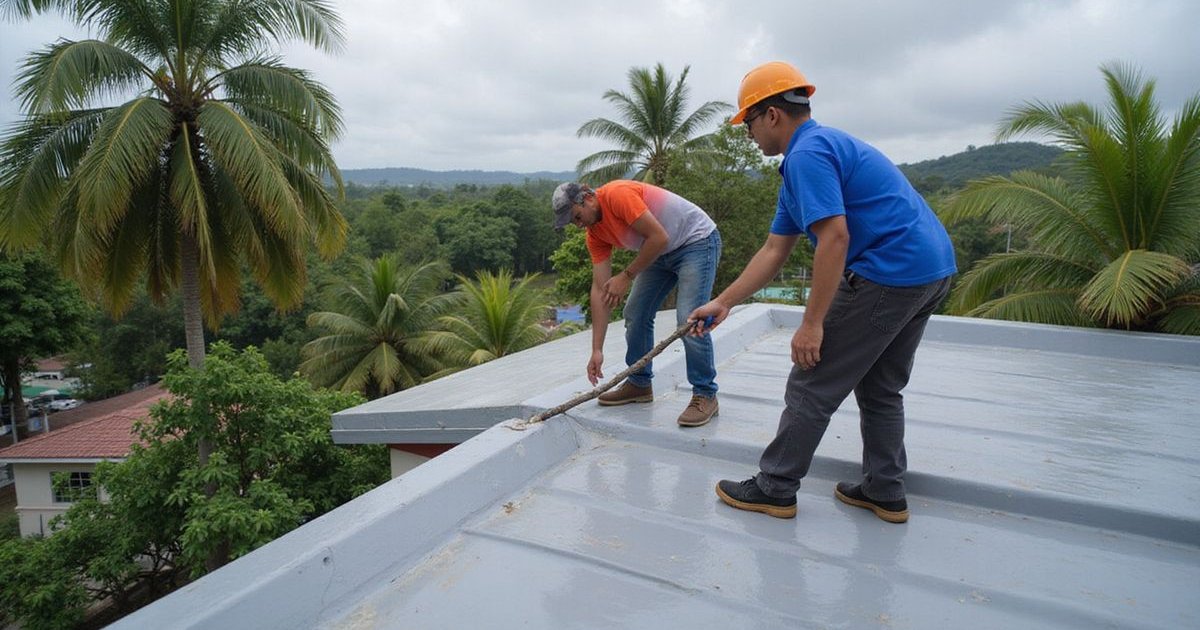
We started Roofing Man back in 2013 with a simple goal: to fix roofs the right way.
After 16 years in this industry, the most common question I hear isn’t about the technical method.
It is almost always about the price.
Waterproofing is a significant investment.
You need to know if the quote you received for your home in Petaling Jaya or KL is fair or inflated.
Understanding these costs helps you budget appropriately.
It also helps you recognize fair pricing when you see it.
This guide breaks down the real market rates for 2026.
We will look at the specific systems that work best for Malaysia’s heavy rainfall.
Then, we will explain exactly what you are paying for.
Cost Overview by System Type
The method you choose dictates the baseline price.
In the Klang Valley, we typically see three main categories of waterproofing.
Liquid membranes are common for smaller repairs.
Torch-applied membranes are the industry standard for concrete (RC) flat roofs.
Here is the current pricing data for 2026 based on local market averages.
| System Type | Cost per sq ft | Cost per sq m | Best Application |
|---|---|---|---|
| Liquid membrane (Acrylic/PU) | RM5-9 | RM54-97 | Minor leaks, balconies |
| Cementitious Waterproofing | RM6-11 | RM65-118 | Bathrooms, internal wet areas |
| Torch-applied membrane (3mm-4mm) | RM10-18 | RM108-195 | RC Flat roofs, large concrete slabs |
| Self-adhesive membrane | RM12-20 | RM130-215 | Areas where open flame is risky |
| PVC/TPO membrane | RM18-28 | RM195-300 | Industrial/Commercial large scale |
Prices include materials and labor. Actual costs vary by project complexity.
Cost by Area Size (Torch-Applied Membrane)
The size of your roof drastically affects the “per square foot” rate.
Contractors have fixed mobilization costs.
Getting a crew, a truck, and equipment to a site in Subang Jaya costs the same whether the roof is 500 sq ft or 2,000 sq ft.
We see the “bulk discount” effect kick in significantly once you pass the 1,000 sq ft mark.
| Roof Size | Estimated Total Cost |
|---|---|
| 500 sq ft (46 sq m) | RM5,000 - RM8,500 |
| 1,000 sq ft (93 sq m) | RM10,000 - RM17,000 |
| 1,500 sq ft (139 sq m) | RM14,000 - RM24,000 |
| 2,000 sq ft (186 sq m) | RM18,000 - RM32,000 |
Larger projects often have lower per-square-foot costs.
Factors Affecting Cost
Every roof in Malaysia is different.
A terrace house in Bangsar faces different challenges than a semi-D in Shah Alam.
These five factors are the primary drivers of your final quote.
1. System Type and Material Brand
Premium systems cost more but typically last longer.
We often recommend proven brands like Sika, Pentens, or Mapei because they handle our tropical heat better.
Generic “white label” materials might save you 15% upfront.
However, they often degrade within three years under the Malaysian sun.
2. Roof Condition and Surface Prep
New waterproofing cannot be applied over a dirty or cracking surface.
If your concrete slab has significant cracks or fungal growth, we must clean and repair it first.
Surface preparation adds to labor time.
This step is critical for adhesion.
Skipping it to save money is the number one reason for premature failure.
3. Complexity and Detail Work
A wide-open flat roof is easy to waterproof.
Roofs with many obstructions are a different story.
Waterproofing around air conditioning compressors, water tanks, and skylights requires manual detail work.
Every corner and pipe penetration needs to be sealed by hand.
This labor-intensive process increases the cost.
4. Access Difficulty
Getting materials to the roof is not always straightforward.
For a standard terrace house, we might need to haul materials up through a manhole or over a balcony.
Hard-to-reach roofs requiring scaffolding or special hoisting equipment add to labor costs.
5. Warranty Length
Longer warranties often come with higher-quality materials.
A standard warranty in Malaysia is usually 5 to 10 years depending on the system.
If you want a 15-year warranty, the contractor likely needs to use a thicker membrane and add an extra protection layer.
This increases the upfront investment.
What’s Included in a Quote
A vague quote is a red flag.
You should always ask for a breakdown of the scope of work.
A proper waterproofing quote should itemize:
- Mobilization: Transport and setup.
- Surface preparation: High-pressure water jetting and crack repair.
- Primer/base coat: The bonding layer.
- Main waterproofing system: The specific product (e.g., “4mm Bitumen Torch-on”).
- Detail work: Treatment of parapet walls, angle fillets, and water outlets.
- Waste Disposal: Removal of debris (very important in strict council areas like DBKL or MBPJ).
- Warranty terms: Specifically what is covered.
Hidden Costs to Watch For
Unexpected expenses can derail your budget.
We always try to identify these during the site inspection, but some issues are only visible once work begins.
Extensive Substrate Repairs Sometimes the concrete screed below the old waterproofing is pulverized. If the concrete is badly damaged, repair costs add up.
Removal of Old Waterproofing Laying new material over old, failed material is risky. Sometimes old failed waterproofing must be removed first to ensure a proper bond.
Protection Screed Waterproofing membranes are not designed for heavy foot traffic. If you plan to use the roof as a patio or dry clothes there, you need a protective layer of cement screed or tiles.
Gradient Correction Ponding water is the enemy of any roof. If water ponding is severe, we may need to re-level the floor to ensure water flows to the drainage outlets.
How to Get Fair Pricing
You want value, not just the lowest number.
Here is how experienced homeowners in the Klang Valley secure the best deals.
1. Get multiple detailed quotes
Do not just ask for a price. Ask for a site visit and a written quotation from at least three reputable contractors.
2. Compare like for like
Ensure every contractor is quoting for the same system. Comparing a simple “paint-on” liquid coating against a 4mm torch-on membrane is not accurate.
3. Verify the “Flood Test”
Ask if they perform a water ponding test after completion. This involves plugging the heavy rain outlets and flooding the area to check for leaks before they leave.
4. Check CIDB Registration
Legitimate contractors in Malaysia should be registered with the CIDB. This ensures they are accountable and meet industry standards.
5. Don’t choose on price alone
The cheapest quote often cuts corners on surface prep. That cheap repair usually fails within 18 months.
Cost vs Value
Ignoring a leak is expensive.
We have seen small drips turn into massive structural issues during the monsoon season.
Consider the alternative costs:
- Repeated patch repairs: RM500-2,000 each time.
- Water damage to ceilings: RM2,000-10,000+ for plaster ceiling replacement.
- Electrical hazards: Water and wiring do not mix.
- Mold remediation: Persistent dampness causes mold that affects air quality.
Quality waterproofing pays for itself by preventing these costs.
Financing Options
Waterproofing is a necessary expense.
Many homeowners delay repairs because of cash flow, but the damage will continue to spread.
If budget is tight:
- Credit Card Installments: Many contractors now accept credit cards. Check if your bank (like Maybank or Public Bank) offers a 0% Easy Payment Plan (EPP).
- Phased Work: Ask if the roof can be done in sections.
- Prioritize Critical Areas: Focus on the active leak zones first if you cannot do the whole roof at once.
Get Your Free Quote
Stop worrying about the next thunderstorm.
Contact us for a free inspection and detailed quote.
We’ll assess your specific situation and provide transparent pricing for professional waterproofing with no hidden costs.